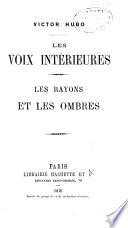
The Luminous Duality of Victor Hugo's Les Rayons et les Ombres
In 1840, the literary world bore witness to the publication of a poetic masterpiece that would indelibly mark the career of Victor Hugo: Les Rayons et les Ombres. This seminal collection of forty-four poems, often translated as "Beams and Shadows" or "Sunlight and Shadows," represents a profound exploration of contrasts, not only in its titular theme of light and darkness but also in its nuanced blend of personal introspection and expansive philosophical inquiry. As Hugo's final major poetic offering before a significant creative pause preceding his political exile, Les Rayons et les Ombres stands as a pivotal work, showcasing the maturation of a literary giant at the height of his powers, bridging lyrical subjectivity with an emerging prophetic social vision.
The very title, les rayons et ombres, immediately invites readers into a world of profound duality. It symbolizes the eternal interplay between joy and sorrow, enlightenment and obscurity, hope and despair. Throughout the collection, Hugo masterfully employs vivid imagery of light (rayons) and shadow (ombres) to evoke these metaphysical contrasts, plumbing the depths of human fate and contemplating the cosmic order. This artistic choice not only lent the poems a rich visual texture but also served as a powerful metaphor for the complex realities of human existence and the socio-political landscape of 19th-century France. Hugo’s unparalleled gift for "color and picturesque detail," as noted by Britannica, allowed him to paint these dualities with breathtaking clarity, making them tangible to the reader.
A Poet's Maturation: From Personal Elegy to Prophetic Vision
Les Rayons et les Ombres marked a significant evolution in Victor Hugo's poetic style. Composed primarily after 1830, the volume seamlessly integrates deeply personal elegies with much broader philosophical investigations into existence, nature, and society. Readers will find poems that resonate with the intimate reflections of Hugo's earlier works like Les Feuilles d'automne (1831), yet expanded with a newfound scope that anticipates his later, more overtly political writings. This collection is where Hugo truly emerges as the "poet-prophet," a figure whose function, according to biographer A.F. Davidson, is to "instruct kings and peoples about the problems of life."
The maturation is evident in Hugo's ability to weave his personal experiences—a life marked by both domestic stability with his wife Adèle Foucher and their children, and the burgeoning demands of public life—into a universal tapestry. The elegiac tones, often exploring themes of loss, memory, and the passage of time, provide an anchor for his more expansive philosophical questions. For instance, pondering the grandeur of nature often leads to reflections on humanity's place within the vast, indifferent cosmos. This blend of individual emotion and universal thought is a hallmark of Hugo's genius in les rayons et ombres, showcasing a poet who was not content merely to express personal emotions but aspired to be the "sonorous echo" of his age, giving voice to its deepest anxieties and aspirations.
Les Rayons et les Ombres in its Historical and Literary Tapestry
To truly grasp the significance of Les Rayons et les Ombres, one must understand the vibrant, often turbulent, backdrop against which it was created.
The July Monarchy and Hugo's Social Consciousness
Published in 1840, the collection arrived during the July Monarchy (1830–1848), a period of constitutional rule under King Louis-Philippe. While this era brought relative political stability after the July Revolution of 1830, it was also characterized by burgeoning social and economic tensions. Industrial expansion was creating new wealth disparities, fueling class discontent that Hugo, then aged 38, observed keenly. By this time, Hugo was a prominent figure, having been honored with the Legion of Honor in 1837 (his election to the Académie Française would follow in 1841). This period marked his deepening engagement with social issues, evidenced by his prior outspoken opposition to capital punishment—a stance that foreshadowed the more sharply critical social commentary that would define his later works. Les Rayons et les Ombres, therefore, subtly incorporates these socio-political currents, reflecting the anxieties and hopes of a society grappling with rapid change under a bourgeois governance that Hugo would later critique with fervor.
A Pinnacle of French Romanticism
Literarily, Les Rayons et les Ombres emerged as a crowning achievement of French Romanticism, a movement Hugo himself had largely defined. His 1827 preface to Cromwell had articulated Romanticism's rejection of classical unities, advocating for a blending of genres and an emphasis on emotion, individualism, and the sublime in nature and history. The 1830 premiere of his play Hernani had ignited the famous "battle" between Romantic innovators and neoclassical traditionalists. Building on earlier poetic volumes like Les Orientales (1829), with its exotic Orientalism, and the introspective Les Feuilles d'automne (1831), les rayons et ombres perfectly exemplified Romantic poetry's dual focus: lyrical subjectivity woven with broader philosophical inquiry. Its vivid imagery and metaphysical contrasts solidified Hugo's reputation as a versatile master of verse, bridging personal elegy with prophetic social vision at a time when Romanticism dominated French letters, pushing against lingering Enlightenment rationalism.
Unpacking the Themes: Beyond Light and Shadow
While the duality of les rayons et ombres is central, the collection delves into a rich tapestry of interconnected themes that offer profound insights into Hugo's mind and the spirit of his age. Beyond the contrasts of light and darkness, joy and sorrow, readers will encounter:
- Nature's Majesty and Solace: Hugo frequently turns to the natural world as a source of inspiration, wonder, and consolation. The grandeur of landscapes, the changing seasons, and the simple beauty of a sunrise or sunset often become metaphors for life's larger cycles and truths.
- Humanity's Place in the Universe: The poems often muse on the scale of human endeavor against the backdrop of cosmic infinity. This leads to meditations on fate, destiny, and the search for meaning in a world that can feel both magnificent and indifferent.
- The Role of the Poet: As the "sonorous echo" of society, Hugo uses his verse to reflect, interpret, and, increasingly, to guide. The poet is portrayed not merely as an observer but as a visionary, capable of perceiving the deeper currents of history and morality.
- Political and Moral Dimensions: Though not overtly polemical, the collection subtly addresses the ideological ferment of the era. Themes of justice, freedom, and the responsibilities of power are explored through allegories and contemplative verses, laying the groundwork for his later, more direct political engagements.
For modern readers, engaging with these diverse themes in Les Rayons et les Ombres provides a powerful connection to the intellectual and emotional landscape of the 19th century. Understanding Hugo's perspective offers invaluable context for appreciating the roots of contemporary social and philosophical debates.
Enduring Legacy and Impact
Les Rayons et les Ombres holds a significant place in Victor Hugo's prodigious output. It represents his final major poetic work before his extended creative pause, lasting until 1853, which coincided with the tumultuous period leading to his exile following the 1851 coup. The critical success of this collection, with its masterful blend of personal and philosophical themes, played a role in solidifying Hugo's reputation as a versatile master of verse, and some biographers suggest it may even have contributed to his election to the Académie Française in 1841. This volume, therefore, acts as a crucial bridge, showcasing the culmination of his early Romantic poetic achievements while foreshadowing the profound political and social engagement that would define much of his later prose and poetry, including monumental works like Les Misérables.
In conclusion, Victor Hugo's Les Rayons et les Ombres is far more than just a collection of poems; it is a profound journey into the heart of duality, a testament to poetic maturation, and a mirror reflecting the historical and literary currents of its time. Through the exquisite interplay of light and shadow, Hugo explores the depths of human experience, offering insights that remain as relevant today as they were in 1840. Its enduring appeal lies in its ability to simultaneously embrace the intimate and the universal, making it an indispensable part of Hugo's legacy and a cornerstone of French Romantic literature.